Introduction to Multi-Modal Optimization
Objectives
Understand what multi-modal optimization is and why it matters
Learn about the SHGA algorithm and its advantages
Know the project objectives and use cases
Why This Matters
The Scenario: A turbine design team has found one blade geometry that meets all stress and efficiency constraints — but is it the only good design? A manufacturing change could make a different geometry cheaper to produce, or a slightly different shape could perform better at off-design conditions. They need an algorithm that finds all viable designs in a single run, not just the single best.
The Research Question: Can a hybrid optimization algorithm — combining genetic algorithms for global exploration with CMA-ES for local refinement — reliably find all global optima of a multi-modal function, from simple 2D problems to challenging 20-dimensional landscapes?
What This Episode Gives You: The big picture — what multi-modal optimization is, how SHGA works at a high level, and why finding multiple solutions matters more than finding just one.
Overview
This repository provides a complete framework for multi-modal optimization using the Scalable Hybrid Genetic Algorithm (SHGA). Multi-modal optimization is the task of finding multiple local or global optima of a function, rather than just a single best solution.
Many real-world optimization problems have multiple good solutions:
Engineering design: Multiple valid configurations that meet constraints
Neural network training: Multiple weight configurations with similar loss
Scheduling problems: Multiple feasible schedules with equal quality
Scientific discovery: Multiple parameter sets that explain observed data
The SHGA algorithm efficiently finds all (or many) of these solutions in a single run.
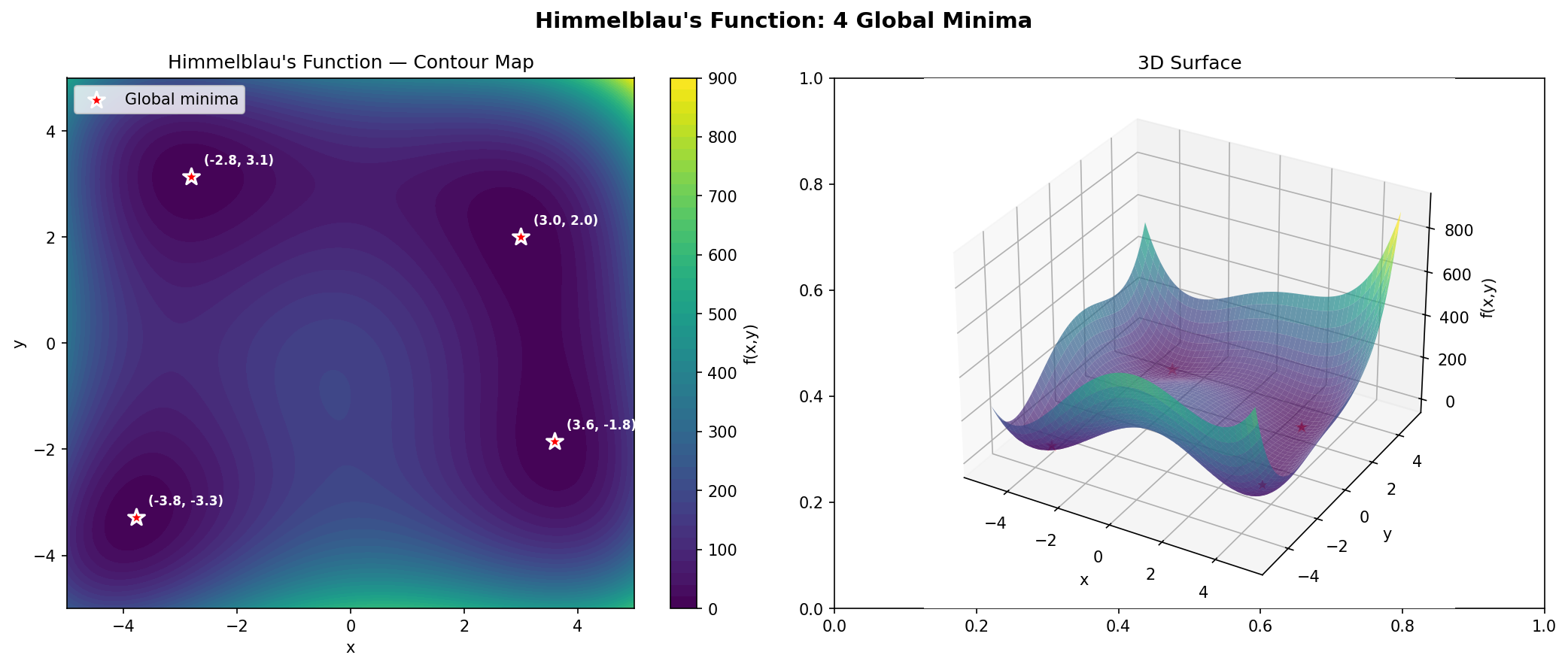
The Himmelblau function — a classic multi-modal test function with 4 global optima (marked as red stars). Multi-modal optimization aims to find all of them in a single run.
The SHGA Algorithm
SHGA (Scalable Hybrid Genetic Algorithm) combines two powerful optimization techniques:
Component |
Purpose |
|---|---|
Deterministic Crowding GA |
Global search - explores the entire domain to find promising regions |
CMA-ES |
Local refinement - accurately locates optima within promising regions |
This hybrid approach provides:
Completeness: Finds many/all optima, not just one
Accuracy: CMA-ES provides high-precision local solutions
Scalability: Works efficiently up to moderate dimensions (10-20D)
Research Paper
This implementation is based on:
Johannsen et al. (2022). A scalable, hybrid genetic algorithm for continuous multimodal optimization in moderate dimensions. Nordic Machine Intelligence.
Self-Contained Repository
This repository is self-contained. Everything you need is included:
Component |
Location |
|---|---|
SHGA algorithm |
|
CEC2013 benchmarks |
|
Benchmark data |
|
Interactive notebook |
|
Dependencies |
|
Simply clone the repository and follow the setup instructions to get started.
Using AI Coding Assistants
If you’re using an AI coding assistant like Claude Code, GitHub Copilot, or Cursor, the repository includes an AGENT.md file with machine-readable instructions. Simply tell your assistant:
“Read AGENT.md and help me run the multi-modal optimization demonstrator on my NAIC VM.”
The agent will be able to set up the environment and run experiments automatically.
What You Will Learn
Episode |
Topic |
|---|---|
02 |
Provisioning a NAIC VM |
03 |
Setting up the environment |
04 |
Understanding the SHGA algorithm |
05 |
Running optimization experiments |
06 |
CEC2013 benchmark functions |
07 |
Analyzing results |
08 |
FAQ and troubleshooting |
09 |
Parallelization on multi-core VMs |
10 |
Visualization guide |
Resources
NAIC Portal: https://orchestrator.naic.no
VM Workflows Guide: https://training.pages.sigma2.no/tutorials/naic-cloud-vm-workflows/
This Repository: https://github.com/NAICNO/wp7-UC6-multimodal-optimization
Keypoints
Multi-modal optimization finds multiple local/global optima, not just one
SHGA combines genetic algorithm (global search) with CMA-ES (local refinement)
The algorithm scales to moderate dimensions (10-20D)
All code and benchmark data are included in this repository