CEC2013 Benchmark Functions
Objectives
Understand the CEC2013 multi-modal benchmark suite
Know the characteristics of each function
Learn how to use benchmarks for testing
Why This Matters
The Scenario: A benchmarking team at a research lab has developed a new multi-modal optimizer and wants to publish results. Reviewers will ask: how does it compare to the state of the art, and on which standard test problems? Without a recognized benchmark suite, every paper invents its own test functions, making comparison impossible.
The Research Question: What is the CEC2013 niching benchmark suite, what makes each of its 20 functions challenging in different ways, and what does a “good” Peak Ratio score actually mean?
What This Episode Gives You: The complete benchmark catalog — function properties, recommended budgets, evaluation code, and how to interpret your results against the standard.
Overview
The CEC2013 benchmark suite is the standard for evaluating multi-modal optimization algorithms. It includes 20 functions with varying:
Dimensions: 1D to 20D
Number of optima: 2 to 216
Basin sizes: Equal to highly unequal
Global/local structure: Some have only global optima, others have many local optima
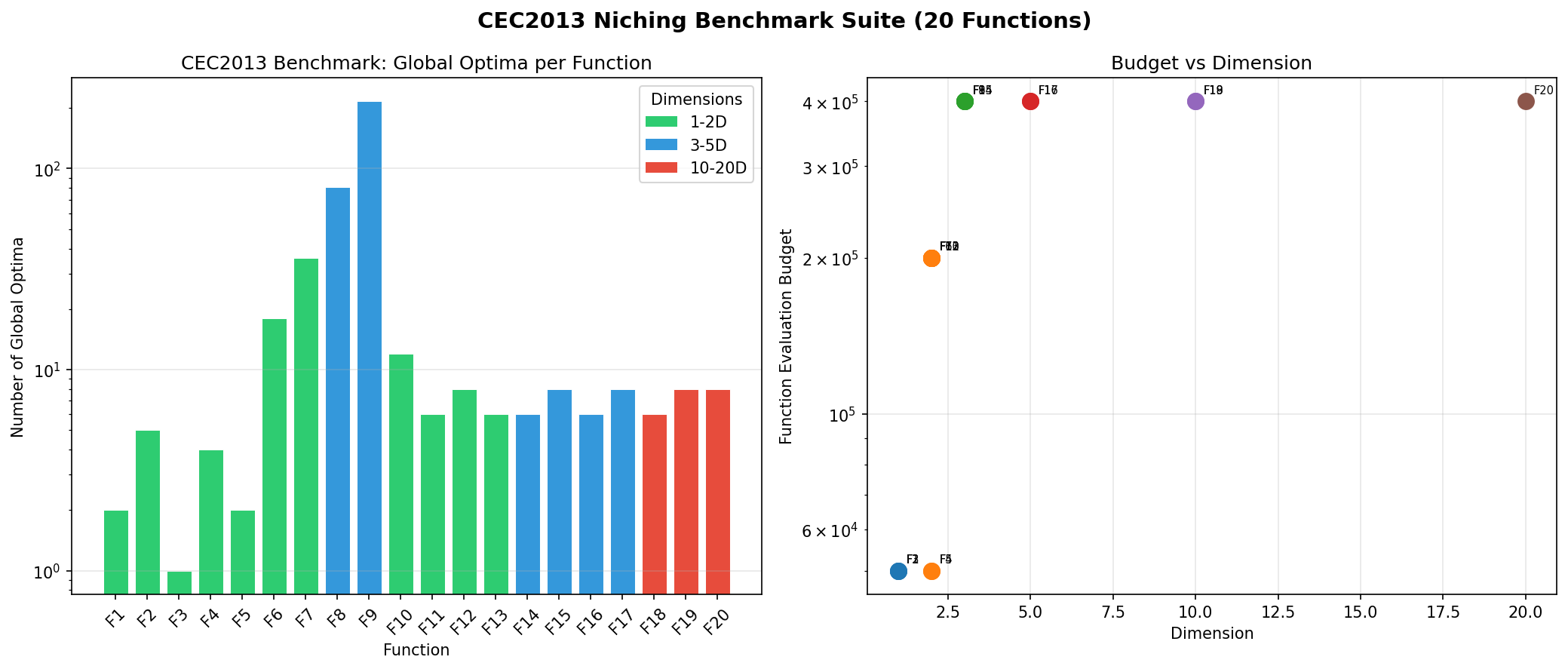
The CEC2013 suite spans 20 functions from 1D to 20D, with 1 to 216 global optima. Colors indicate dimensionality: green (1-2D), blue (3-5D), red (10-20D).
Function Catalog
Low-Dimensional (1-2D)
ID |
Name |
Dim |
Global Optima |
Budget |
|---|---|---|---|---|
F1 |
Five-Uneven-Peak Trap |
1 |
2 |
50,000 |
F2 |
Equal Maxima |
1 |
5 |
50,000 |
F3 |
Uneven Decreasing Maxima |
1 |
1 |
50,000 |
F4 |
Himmelblau |
2 |
4 |
50,000 |
F5 |
Six-Hump Camel Back |
2 |
2 |
50,000 |
F6 |
Shubert |
2 |
18 |
200,000 |
F7 |
Vincent |
2 |
36 |
200,000 |
Composition Functions (2-20D)
ID |
Name |
Dim |
Global Optima |
Budget |
|---|---|---|---|---|
F8 |
Modified Rastrigin - All Global |
2 |
12 |
400,000 |
F9 |
Composition Function 1 |
2 |
6 |
400,000 |
F10 |
Composition Function 2 |
2 |
8 |
400,000 |
F11 |
Composition Function 3 |
2 |
6 |
200,000 |
F12 |
Composition Function 4 |
3 |
8 |
400,000 |
F13-F20 |
Higher Dimensional |
3-20 |
6-216 |
400,000 |
Using Benchmarks
Loading a Function
from cec2013.cec2013 import CEC2013, how_many_goptima
import numpy as np

# Load Himmelblau function (F4)
f = CEC2013(4)

# Get function information using direct methods
dim = f.get_dimension()
n_optima = f.get_no_goptima()
f_best = f.get_fitness_goptima()
budget = f.get_maxfes()

print(f"Name: Himmelblau (F4)")
print(f"Dimension: {dim}")
print(f"Number of global optima: {n_optima}")
print(f"Global optimum value: {f_best}")
print(f"Recommended budget: {budget}")

# Get bounds (must iterate over dimensions)
lb = [f.get_lbound(k) for k in range(dim)]
ub = [f.get_ubound(k) for k in range(dim)]
print(f"Lower bounds: {lb}")
print(f"Upper bounds: {ub}")

# Evaluate function
x = np.array([3.0, 2.0])  # Near one of the optima
value = f.evaluate(x)
print(f"f({x}) = {value}")
Checking Found Optima
# Use how_many_goptima to check found solutions
solutions = np.array([[3.0, 2.0], [-2.8, 3.1]])  # Example solutions
accuracy = 0.0001
count, seeds = how_many_goptima(solutions, f, accuracy)
print(f"Found {count}/{n_optima} global optima")
Function Details
F1: Five-Uneven-Peak Trap (1D)
Domain: [0, 30]
5 peaks with different heights and widths
2 global optima at x = 0 and x = 30
F4: Himmelblau (2D)
Domain: [-6, 6]^2
Classic test function with 4 global optima
Located at approximately:
(3.0, 2.0)
(-2.805, 3.131)
(-3.779, -3.283)
(3.584, -1.848)
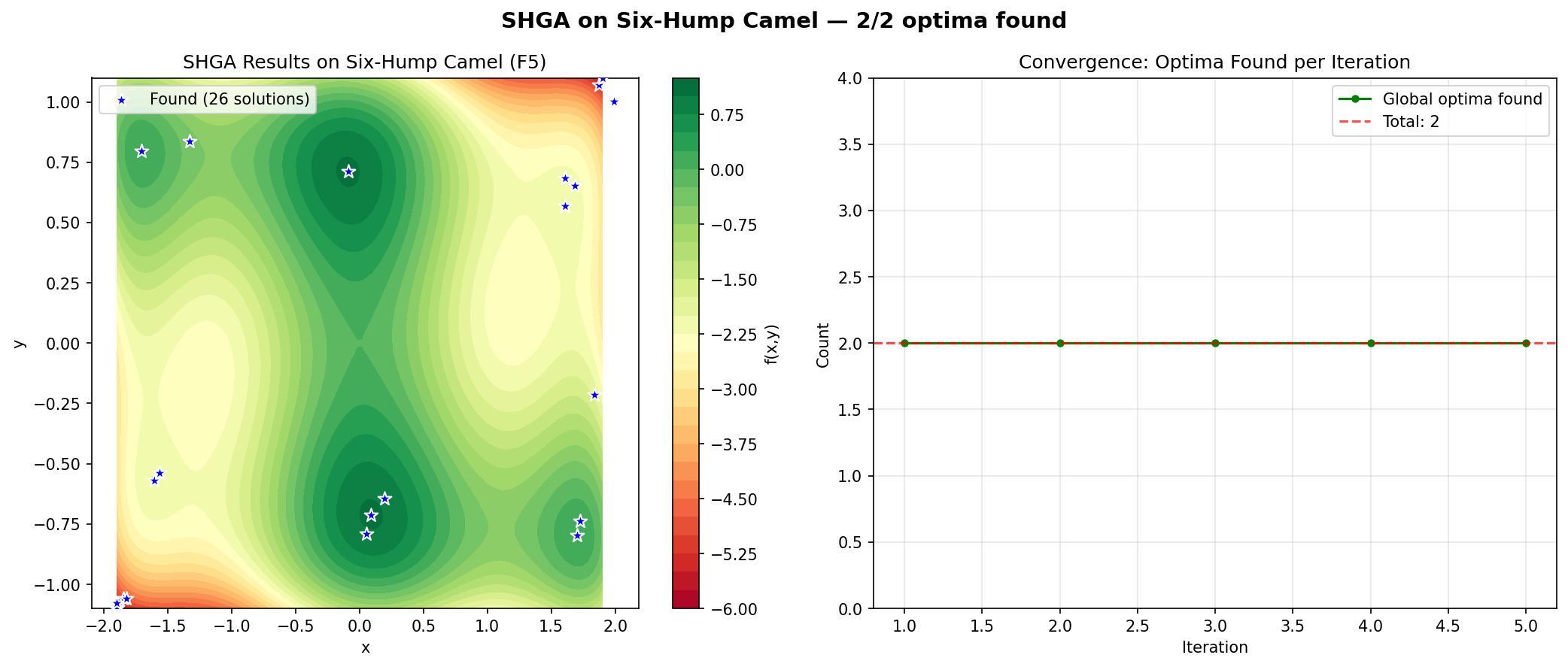
SHGA on the Six-Hump Camel (F5) — both global optima found with rapid convergence.
F6: Shubert (2D)
Domain: [-10, 10]^2
760 local optima, 18 global optima
All global optima have the same function value
Tests ability to find many optima
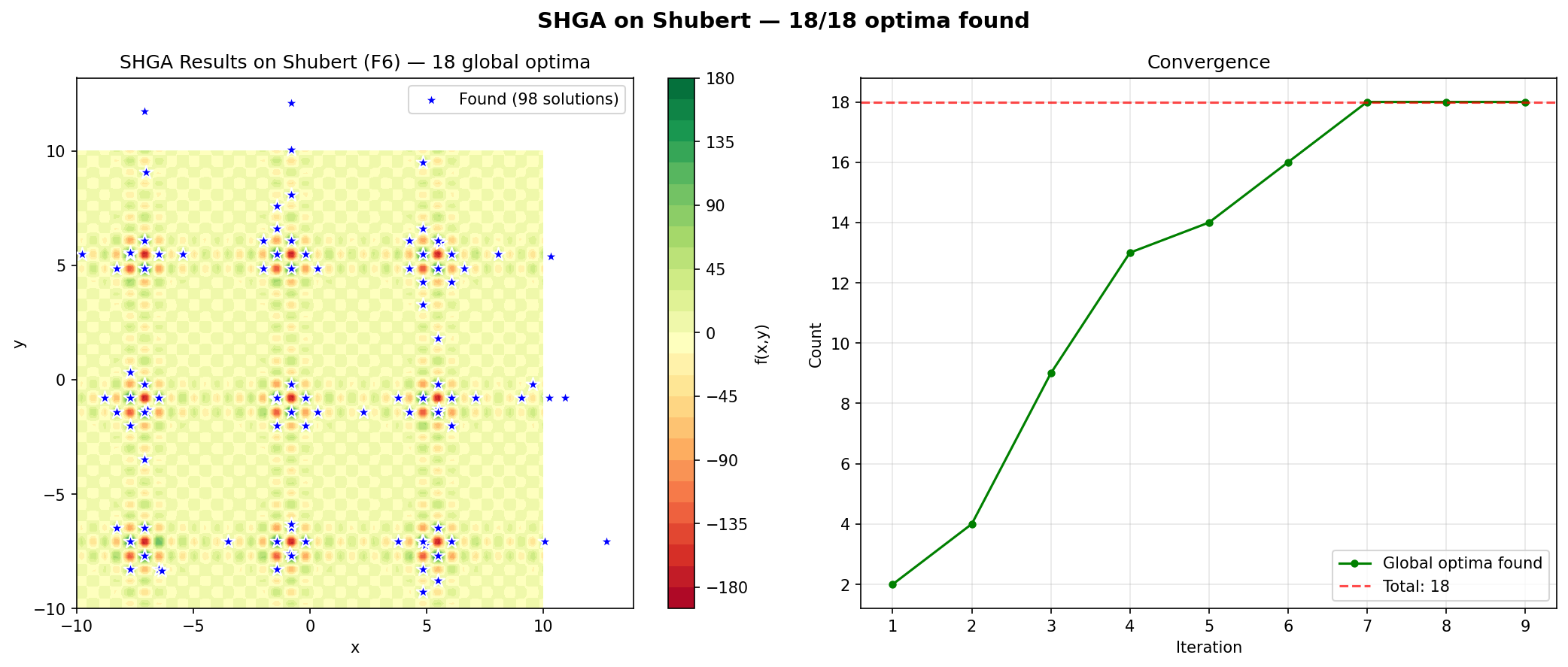
SHGA on the Shubert function (F6) — the algorithm must find 18 global optima scattered across a complex landscape with 760 local optima.
F7: Vincent (2D)
Domain: [0.25, 10]^2
36 global optima in a regular pattern
Each optimum in a separate basin
Tests systematic coverage of the domain
Performance Metrics
Peak Ratio (PR)
The standard metric for multi-modal optimization:
PR = (Number of found global optima) / (Total known global optima)
A solution is “found” if it’s within accuracy threshold of a true optimum:
Accuracy Level |
Distance Threshold |
|---|---|
1e-1 |
0.1 |
1e-2 |
0.01 |
1e-3 |
0.001 |
1e-4 |
0.0001 |
1e-5 |
0.00001 |
Computing PR with CEC2013
The CEC2013 module provides how_many_goptima() to compute the peak ratio:
from cec2013.cec2013 import CEC2013, how_many_goptima

# After running optimizer...
f = CEC2013(4)  # Himmelblau
n_optima = f.get_no_goptima()

# Get found solutions (without function values)
found_solutions = optimizer.xy[:, :-1]

# Compute how many global optima were found
accuracy = 0.0001  # Distance threshold
count, seeds = how_many_goptima(found_solutions, f, accuracy)

# Peak ratio
pr = count / n_optima
print(f"Found {count}/{n_optima} global optima")
print(f"Peak Ratio: {pr:.2%}")
Choosing Functions for Testing
Purpose |
Recommended Functions |
|---|---|
Quick testing |
F4 (Himmelblau), F5 (Six-Hump Camel) |
Many optima |
F6 (Shubert), F7 (Vincent) |
Scalability |
F11-F20 (higher dimensions) |
Algorithm comparison |
F1-F7 (standard benchmark) |
Keypoints
CEC2013 provides 20 standardized benchmark functions
Functions range from 1D to 20D with 1 to 216 optima
Peak Ratio (PR) is the standard performance metric
Use F4 (Himmelblau) for quick testing
Higher functions (F8+) test scalability to more dimensions