Understanding the SHGA Algorithm
Objectives
Understand the two-phase hybrid approach
Learn how deterministic crowding maintains diversity
Understand how CMA-ES refines solutions
Know how to configure algorithm parameters
Why This Matters
The Scenario: A process engineer running a chemical reactor knows there are multiple operating points that maximize yield — different temperature-pressure-flow combinations that all produce good results. A standard optimizer converges to whichever optimum it stumbles on first, but she needs all of them so operators can switch between regimes depending on feedstock availability.
The Research Question: How does deterministic crowding prevent a genetic algorithm from collapsing onto a single optimum, and how does the two-phase seed-solve-collect cycle combine global exploration with high-precision local refinement?
What This Episode Gives You: The algorithm internals — GA with niching, CMA-ES local search, and how to configure budget, population size, and convergence tolerances.
Algorithm Overview
The Scalable Hybrid Genetic Algorithm (SHGA) uses a seed-solve-collect paradigm:
        flowchart LR
    A[Initialize Population] --> B[Deterministic Crowding GA]
    B --> C[Extract Seeds]
    C --> D[CMA-ES Local Search]
    D --> E[Collect Solutions]
    E --> F{Budget Exhausted?}
    F -->|No| B
    F -->|Yes| G[Return All Solutions]
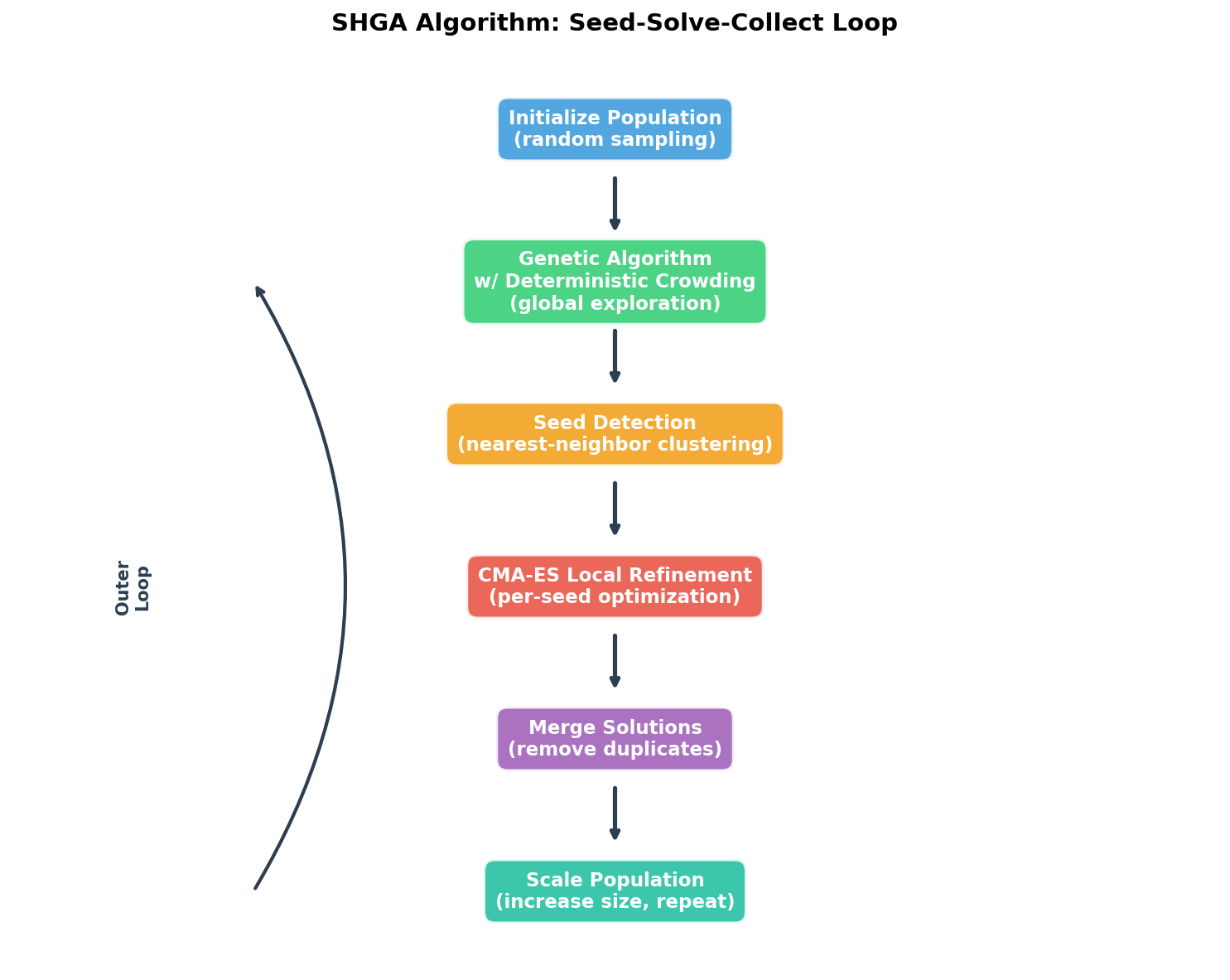
The SHGA algorithm iterates through initialization, genetic algorithm exploration, seed detection, CMA-ES local refinement, solution merging, and population scaling.
Phase 1: Global Search (Deterministic Crowding GA)
The first phase explores the entire search space using a genetic algorithm with deterministic crowding:
Population Initialization: Random points sampled uniformly in the domain
Selection: Tournament selection for parent pairs
Crossover: BLX-alpha blend crossover
Mutation: Gaussian mutation with adaptive step size
Replacement: Child replaces most similar parent (deterministic crowding)
Why Deterministic Crowding? Standard GAs converge to a single optimum. Deterministic crowding maintains niches - subpopulations around different optima - by ensuring children only compete with similar parents.
Phase 2: Local Refinement (CMA-ES)
After the GA identifies promising regions, CMA-ES (Covariance Matrix Adaptation Evolution Strategy) refines each seed to high precision:
Adaptive step size: Automatically adjusts search radius
Covariance learning: Learns the local landscape shape
Invariance properties: Works well regardless of coordinate system
CMA-ES is widely considered the state-of-the-art for local optimization in continuous spaces.
The Seed-Solve-Collect Cycle
Each iteration:
Seed: Extract promising candidates from GA population
Solve: Run CMA-ES from each seed
Collect: Add converged solutions to the solution set
This continues until the function evaluation budget is exhausted.
Key Algorithm Components
MultiModalMinimizer Class
The main entry point is mmo.minimize.MultiModalMinimizer:
from mmo.minimize import MultiModalMinimizer
from mmo.domain import Domain

# Define search domain
domain = Domain(boundary=[[-5, -5], [5, 5]])  # 2D box

# Create optimizer
optimizer = MultiModalMinimizer(
    f=my_function,        # Function to minimize
    domain=domain,        # Search space
    budget=50000,         # Max function evaluations
    max_iter=50,          # Max outer iterations
    verbose=1             # Output level (0-3)
)

# Run optimization
for result in optimizer:
    print(f"Iteration {result.number}: {result.n_sol} solutions found")

# Get all solutions
solutions = optimizer.xy  # Shape: (n_solutions, dim+1)
x_values = solutions[:, :-1]  # Solution coordinates
f_values = solutions[:, -1]   # Function values
Domain Class
Defines an axis-parallel hypercuboid search space:
from mmo.domain import Domain

# 2D domain: x in [-5, 5], y in [-5, 5]
domain_2d = Domain(boundary=[[-5, -5], [5, 5]])

# 10D domain: each dimension in [0, 1]
domain_10d = Domain(boundary=[[0]*10, [1]*10])
Configuration
Algorithm parameters are controlled via mmo.config.Config:
Parameter |
Default |
Description |
|---|---|---|
|
100 |
GA population size |
|
50 |
GA generations per iteration |
|
0.9 |
Crossover probability |
|
0.1 |
Mutation probability |
|
0.5 |
CMA-ES initial step size |
|
1e-8 |
CMA-ES convergence tolerance |
Algorithm Parameters
Choosing Budget
The budget (max function evaluations) depends on:
Dimension: Higher dimensions need more budget
Number of optima: More optima need more exploration
Function cost: Expensive functions may need smaller budgets
CEC2013 recommended budgets:
Functions |
Dimension |
Optima |
Budget |
|---|---|---|---|
F1-F5 |
1-2D |
1-5 |
50,000 |
F6-F7 |
2D |
18-36 |
200,000 |
F8-F20 |
2-20D |
6-216 |
400,000 |
Verbosity Levels
Level |
Output |
|---|---|
0 |
Silent |
1 |
Summary per iteration |
2 |
+ GA details |
3 |
+ CMA-ES details |
Keypoints
SHGA combines genetic algorithm (global) with CMA-ES (local)
Deterministic crowding maintains population diversity around multiple optima
The seed-solve-collect cycle iteratively refines solutions
Budget scales with dimension and number of expected optima