PINN Methodology
Objectives
Understand the electrochemistry behind PEM voltage prediction
Learn about the Teacher-Student PINN architecture
Know why knowledge distillation improves OOD generalization
Understand the role of each physics parameter
Know why baseline comparisons matter for validating the physics approach
Why This Matters
The Scenario: A control systems engineer is designing a model predictive controller (MPC) for a PEM electrolyzer stack. She needs a voltage model that runs in under 5 ms per prediction, respects known electrochemistry (Nernst, Butler-Volmer, Ohmic losses), and doesn’t produce nonsense at high pressures the stack hasn’t been tested at yet. A pure neural network is fast but unreliable outside training data; a full CFD simulation is accurate but takes hours.
The Research Question: Does embedding electrochemical equations directly into the model architecture — rather than hoping a neural network learns the physics from data alone — produce measurably better out-of-distribution generalization? And how much of a large teacher model’s knowledge can be compressed into just 12 physics parameters?
What This Episode Gives You: The electrochemistry behind every term in the voltage equation, the teacher-student architecture, and why each training choice (SGD vs Adam, different schedulers) was made.
Voltage Decomposition
The total cell voltage is the sum of multiple components:
V_cell = V_rev + V_act + V_ohm + V_conc + V_corr
Where:
V_rev: Reversible (Nernst) voltage - thermodynamic minimum
V_act: Activation overpotential - kinetic losses (anode + cathode)
V_ohm: Ohmic overpotential - resistance losses
V_conc: Concentration overpotential - mass transport losses
V_corr: Hybrid correction - small logistic correction (clamped to +/-100 mV)
1. Nernst Equation (Reversible Voltage)
V_rev = 1.229 - 0.9x10^-3(T - 298.15) + (RT/nF) x ln(P_H2 x sqrt(P_O2) / P_H2O)
2. Butler-Volmer (Activation Overpotential)
eta_act = (RT / alphanF) x arcsinh(i / 2*i0)
Separate anode and cathode contributions with individual transfer coefficients (alpha_a, alpha_c) and exchange current densities (i0_a, i0_c). Exchange currents use Arrhenius temperature scaling.
3. Ohmic Loss
V_ohm = i x R_ohm
Temperature-dependent resistance with Arrhenius scaling: R_ohm = R_ohm_ref x exp(-E_R/R x (1/T - 1/T_ref)).
4. Concentration Overpotential
eta_conc = -(RT/nF) x ln(1 - i/i_lim)
Where i_lim depends on pressure via Fick’s law and temperature via diffusion scaling.
5. Hybrid Correction
delta_corr = clamp( (a x sigmoid(b x (i - c)) + d) x (1 + p x dP/P_ref + t x dT/T_ref), +/-0.1V )
A small logistic correction with pressure and temperature modulation, accounting for effects not captured by the first four terms.
6-Model Comparison Framework
The notebook trains 6 models to answer the key question: does embedding physics help generalization, or can a large enough neural network learn the physics from data alone?
Pure ML Baselines (No Physics)
Model |
Architecture |
Parameters |
|---|---|---|
PureMLP |
[4 -> 128 -> 64 -> 1] |
~2,000 |
BigMLP |
[4 -> 256 -> 128 -> 64 -> 1] |
~50,000 |
Transformer |
Self-attention + MLP |
~50,000 |
All baselines use SGD + CosineAnnealingLR + early stopping for a fair comparison.
Physics-Informed Models
Model |
Architecture |
Parameters |
Training |
|---|---|---|---|
Teacher |
Physics equations + MLP residual |
~9,000 |
SGD on labels |
Pure Physics |
Physics equations + logistic correction |
12 |
Adam on labels only (alpha=1.0) |
Distilled Student |
Physics equations + logistic correction |
12 |
Adam on 10% labels + 90% teacher |
Teacher Model: HybridPhysicsMLP
The teacher combines physics equations with an MLP residual:
8 learnable physics parameters: exchange currents, resistance, transfer coefficients, corrections
MLP residual: [4 -> 128 -> 64 -> 1] with LayerNorm, GELU, Dropout
Total: ~9,354 parameters
Training: SGD optimizer (NOT Adam!) + CosineAnnealingLR
The MLP correction is clamped to +/-100 mV to prevent overfitting.
Why SGD Over Adam?
Adam adapts learning rates per-parameter, which can overfit to IID validation data. SGD with momentum provides smoother optimization landscapes and better OOD generalization. This is demonstrated empirically in the ablation study (notebook Part 9).
Student Model: PhysicsHybrid12Param
The student is a pure physics model with hybrid corrections:
6 learnable physics parameters: i_lim_ref, i0_a_ref, i0_c_ref, R_ohm_ref, alpha_a, alpha_c
6 fixed physics constants (registered as non-learnable buffers):
Constant |
Symbol |
Value |
Source |
|---|---|---|---|
Anode activation energy |
E_a,a |
50 kJ/mol |
Literature (Ir catalysts) |
Cathode activation energy |
E_a,c |
60 kJ/mol |
Literature (Pt catalysts) |
Ohmic activation energy |
E_R |
15 kJ/mol |
Literature (Nafion membrane) |
Temperature exponent |
gamma |
0.2 |
Empirical |
Pressure exponent (Fick’s law) |
beta |
0.7 |
Fick’s law scaling |
Reference temperature |
T_ref |
353.15 K (80°C) |
Experimental design |
6 learnable hybrid corrections: logistic function with pressure/temperature modulation
Total: 12 learnable parameters
Parameter Constraints
Physics parameters use constrained representations to guarantee physically valid values:
Positive quantities (exchange currents, resistance, limiting current): stored in log-space, exponentiated at runtime
Transfer coefficients: stored as raw values, mapped through sigmoid to [0.3, 1.0]
Knowledge Distillation
The student is trained with a combined loss:
Loss = alpha x MSE(student, labels) + (1-alpha) x MSE(student, teacher)
With alpha = 0.1 (10% labels, 90% teacher), the student learns the teacher’s implicit physics understanding, resulting in better OOD generalization with far fewer parameters.
Pure Physics vs Distilled Student
Both have the same 12-parameter architecture. The only difference is training:
Pure Physics (alpha=1.0): learns from labels only, no teacher signal
Distilled Student (alpha=0.1): learns 90% from teacher, which acts as a regularizer
The distillation benefit is typically 5-10 mV improvement in OOD performance.
Training Configuration
The teacher and student use deliberately different training configurations. These choices are empirically validated in the ablation study (notebook Part 9).
Teacher Training
Setting |
Value |
Rationale |
|---|---|---|
Optimizer |
SGD(lr=0.01, momentum=0.9, weight_decay=1e-4) |
Smoother optimization prevents MLP overfitting |
Scheduler |
CosineAnnealingLR(T_max=epochs, eta_min=0.0001) |
Gradual decay to fine learning rate |
Loss |
MSE (mean squared error, in Volts) |
Standard regression loss |
Epochs |
100 |
Sufficient for convergence with early stopping |
Early stopping |
patience=30 |
Stops 30 epochs after last improvement |
Gradient clipping |
max_norm=1.0 |
Prevents exploding gradients from physics terms |
Validation metric |
MAE in millivolts |
More interpretable than MSE for comparison |
The teacher typically converges early (best epoch ~17-30) and early stopping terminates training well before 100 epochs.
Student Training
Setting |
Value |
Rationale |
|---|---|---|
Optimizer |
Adam(lr=0.001, weight_decay=1e-5) |
Adaptive rates help sparse 12-param model converge |
Scheduler |
ReduceLROnPlateau(factor=0.5, patience=10) |
Halves LR when validation stalls for 10 epochs |
Loss |
alpha x MSE(student, labels) + (1-alpha) x MSE(student, teacher) |
Combined distillation loss |
Epochs |
200 |
More epochs needed for plateau-based scheduling |
Early stopping |
patience=40 |
Longer patience since ReduceLROnPlateau needs time |
Gradient clipping |
max_norm=1.0 |
Same as teacher |
Validation metric |
MAE in millivolts |
Same as teacher |
Why Different Optimizers?
The teacher has ~9,000 parameters including an MLP with weight matrices. SGD with momentum prevents the MLP from overfitting to training-specific patterns, which is critical for OOD generalization. This is the single most impactful training choice, as shown in the ablation study.
The student has only 12 constrained physics parameters (stored in log-space or sigmoid-bounded). Adam’s per-parameter adaptive learning rates help these sparse, heterogeneous parameters converge efficiently. Since the student has no MLP, the overfitting risk that SGD addresses does not apply.
Baseline Training
All pure-ML baselines (PureMLP, BigMLP, Transformer) use the same configuration as the teacher for fair comparison:
SGD(lr=0.01, momentum=0.9, weight_decay=1e-4) + CosineAnnealingLR
100 epochs, patience=30, gradient clipping max_norm=1.0
This ensures differences in OOD performance are due to architecture (physics vs no physics), not training choices.
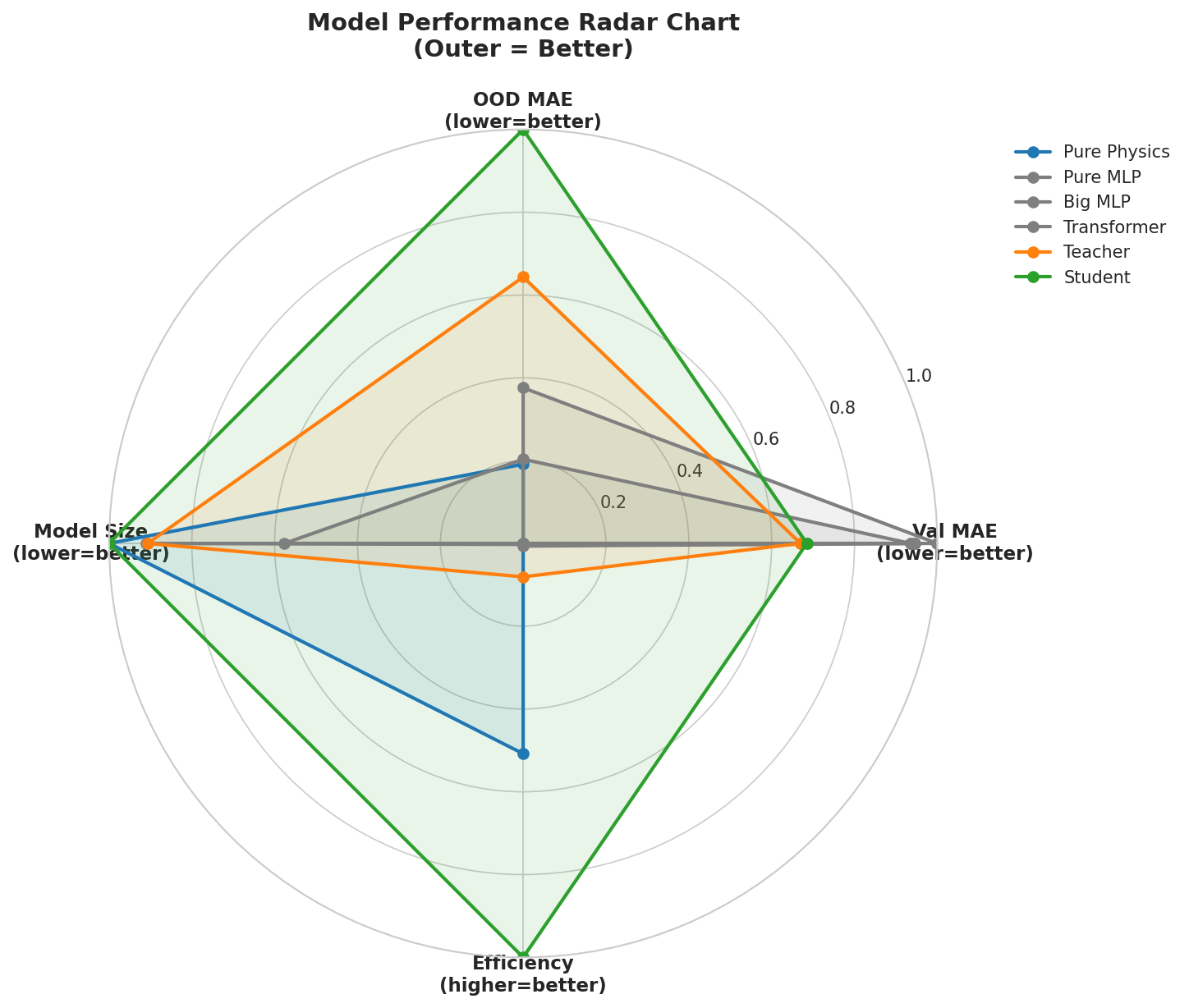
Multi-dimensional radar comparison of all 6 models. The student (green) achieves the best overall balance across accuracy, OOD generalization, and model simplicity.
The 12-Number Equation
After training, the distilled student reduces to a closed-form equation:
V_cell = E_nernst(T, P_H2, P_O2) + eta_act_a(i, T) + eta_act_c(i, T)
       + eta_ohm(i, T) + eta_conc(i, T, P) + delta_corr(i, T, P)
Each term is an explicit function of operating conditions and the 12 learned constants. The notebook (Part 11) implements this as a standalone NumPy function and verifies it matches the PyTorch model to micro-volt precision. This means:
No neural network at deployment
Reproducible in any programming language or spreadsheet
Every parameter has direct physical interpretation
The model can be published as a table of 12 numbers
Keypoints
Cell voltage = V_rev + V_act + V_ohm + V_conc + V_corr (5 physical components)
6 models compared: 3 pure-ML baselines + teacher + pure physics + distilled student
Teacher: SGD + CosineAnnealingLR, 100 epochs, patience=30
Student: Adam + ReduceLROnPlateau, 200 epochs, patience=40
Different optimizers for different architectures: SGD prevents MLP overfitting, Adam helps sparse physics params
All baselines use SGD for fair comparison
Gradient clipping (max_norm=1.0) stabilizes physics-constrained training
MSE for training loss, MAE in mV for evaluation
Knowledge distillation with alpha=0.1 transfers physics understanding
The trained student IS a deterministic equation, reproducible from 12 numbers
Keep-out validation ensures the model generalizes to unseen conditions